A couple years ago I blogged an essay here about the US Navy’s Littoral Combat Ship program, and how it epitomized the United States’ badly managed defense procurement system. This post is a brief update, recounting what’s happened since then.
As a recap, the LCS program was a mess from the start, with grotesque cost overruns, contractors given leave to write checks on the government’s behalf, and most bizarrely, building two different models of LCS. In hindsight, the choice to invest in both the Lockheed Martin team’s LCS-1, USS Freedom and the General Dynamics team’s LCS-2, USS Independence, still looks like what it resembled in 2004: a crude attempt to spread the pork around as many Congressional districts and defense contractors as possible.
This is sad irony because the Navy’s public mantra for procurement at the time was “faster, better, cheaper,” and an attempt to get away from the gold-plated supership projects left over from the Reagan era. Two examples of these are the bloated CG-X/DD-X/DD-21/DDG-1000 destroyer project which is finally reached the prototype stage as the three-ship Zumwalt class, and the Virginia-class nuclear attack submarine that was supposed to be a cheap alternative to the Seawolf, but which wound up costing just as much.
Unfortunately, under Secretary of Defense Rumsfeld, “faster, better, cheaper” was implemented as farming the whole project out to contractors on cost-plus contracts that essentially gave the contractor a blank check, and allowing the ‘cheap’ LCS to mutate into a smaller version of a gold-plated supership. The final cost of USS Freedom was $645 million, and that for USS Independence was $704 million, exclusive of repairs and modifications needed after trials. This is 3 to 3.5 times the original budget for each ship, which quite defeated the point of the LCS as an inexpensive ship for primarily low-intensity conflict.
The inability to get what taxpayers pay for is not just an appalling waste of money, but also a major weakness in the US military. Being ‘strong on defense’ isn’t just a matter of spending money on defense; it must include ensuring the money is wisely and properly spent. The longer a weapon, ship, or aircraft lingers in development hell, the more likely it is to be cancelled. The money already spent on the project is gone forever, and the military has to do without the ship or missile or vehicle it needed—for example, in the late 1990s the US Navy had to bite the bullet and do without the replacement for the A-6 Intruder bomber, which essentially halved a carrier’s strike radius, and the Marines continue to make do with elderly, lumbering AAV-7 amtracs now that the Expeditionary Fighting Vehicle has sunk.
Right now, with the fleet stretched thin, the Navy really needs the LCS, and needs it to work properly.
Sighted Scam, Sank Same
The LCS almost went by the boards the same way. After four years of delays and cost overruns, in November 2007, Navy Secretary Donald Winter cancelled the LCS program outright with a vitriolic outburst at the two teams of contractors, in the culmination of a summer of discontent that saw the LCS program manager fired, the admiral in charge of shipbuilding reassigned to other duties, and work stopped on two further ships (LCS 3, USS Fort Worth and LCS-4, USS Coronado) that were under construction.
This wasn’t the only shipbuilding program that had pitted the Navy against the Navy’s contractors. Only a few months previously, Secretary Winter had blasted Northrop-Grumman (the Navy’s largest shipbuilder), Raytheon, and the other contractors involved in one of the Navy’s other projects, the mechanically-defective and grossly over-budget ($1.68 billion, $840 million over budget) USS San Antonio. The San Antonio was not only three years late entering service, but was $840 million over budget and plagued by humiliating mechanical and electronics failures, some of which were so egregious that they were introduced as evidence at the court-martial of one of the ship’s officers after one of the ship’s crew was killed in a machinery-related accident. As of October 2010, the Navy faced another $38 million in costs to repair defective work and make the ship usable. Winter complained "Twenty-three months after commissioning of LPD 17 [the USS San Antonio], the Navy still does not have a mission-capable ship.” As of April 2011, the San Antonio had been in dockyard hands for a year for engine repairs and other concerns.
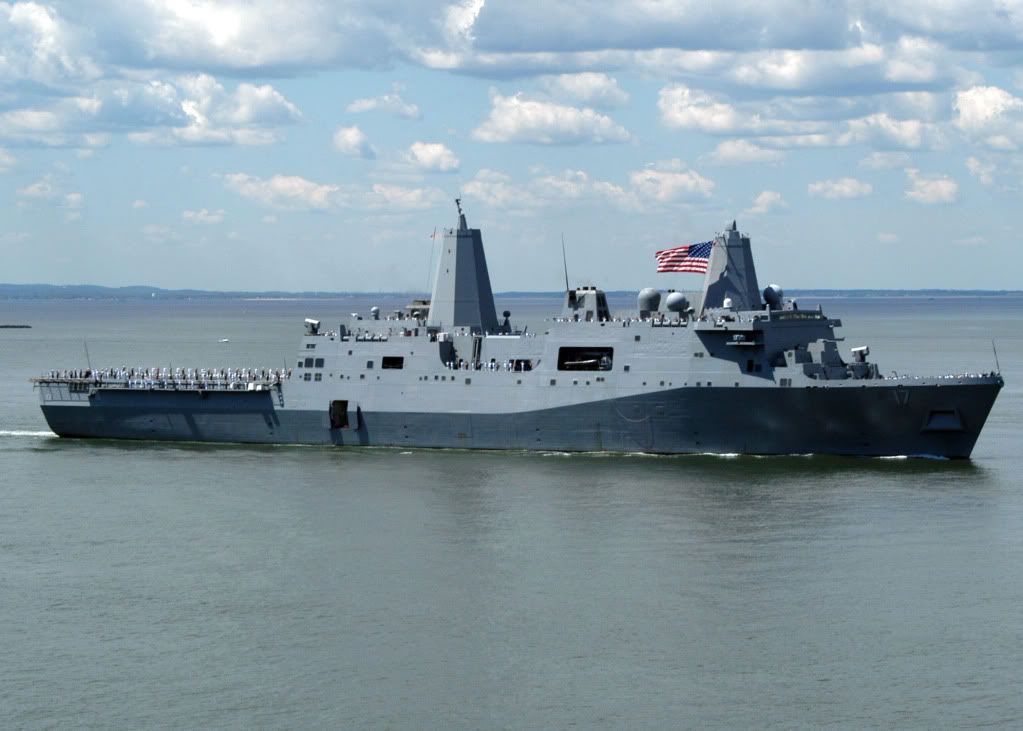
The USS San Antonio, at sea
Secretary Winter decried lack of competition in the shipbuilding market, an industry where virtually every major defense contractor has a piece of any given project, and specifically complained about the ‘eroded expertise’ of the government in warship design and construction, and argued that excessive delegation of design and construction responsibilities to the private sector—part of the privatization campaign of Secretary of Defense Rumsfeld-- was the root cause of the problem, since it stripped the Navy of most of its oversight of the design and construction of the ships it was paying for.
Rather ironically, Secretary Winter was himself a Northrop-Grumman executive from 2002 through 2005, after Northrop brought out the firm TRW, of which Winter was CEO.
This behavior from the Navy’s leadership was as out of character as a temper tantrum in a Trappist monastery, and the defense contractors who had been happily feeding off of Uncle Sam’s largesse were understandably shocked.
Indeed, the contractors were so shocked that they agreed to Secretary Winter’s fixed-price demand—and not only that, cut their prices in attempts to underbid each other. It was nothing short of hilarious to see corporations like General Dynamics so gobsmacked at having to accept the free market where they had expected a monopoly (or a kleptocracy, depending on your point of view).
The end result, announced in November 2010, was a resounding win for the government and the Navy, though-- if the Navy would have more LCSs, they’d be built at a fixed cost, with the builders eating any overruns. Granted, it’s 20 ships rather than the 55 originally called, for and the fixed cost is reported to be $450 million per ship (just shy of a Congress-mandated cap of $460 million each), more than twice the original planned cost. It’s still less than the cost of the prototypes.
Most importantly, in 2010 the Navy was finally allotted sufficient funds to for enough Supervisor of Shipbuilding officers for all ships under construction, in order to verify that ships were being constructed to specification.
Nonetheless, Admiral Mike Mullen, Chairman of the Joint Chiefs of Staff, said in October 2010 “If LCS is unable to contain itself … then I don’t think it has much of a future.” Further problems are entirely possible, including issues that could render the design useless, and the performance of the first several ships will be taken into account.
The rather questionable thing is that after the shouting died down, the Navy decided to go ahead with both designs after all, ordering ten ships of each type in addition to the four completed or under construction, all to be paid for by 2015 and in service by 2018. The two LCS designs are distinct, it is true, but neither of them is significantly better than the other, and the trimaran Independence design costs more than the steel monohull Freedom type, although the Independence has more cargo space. Furthermore, the aluminum trimaran Independence design produced by the General Dynamics team (now headed by Austal) will be the first warship of its type to see service, which raises a whole new set of engineering challenges and maintenance concerns. The Independence also introduces a wholly new data and communications system, while the Freedom has an improved version of the Navy’s standard system. Construction work is also hindered by the two ‘teams’ having changed their rosters—the erstwhile General Dynamics design is now managed by shipbuilder Austal, and the shipyard at which the Lockheed design is being built was bought out by the Italian firm Ficantieri. To further complicate matters, Austal and General Dynamics have recently parted ways; Austal will build the next USS Independence-type (General Dynamics type) LCS competing with them. Still worse, although Austal built the Independence, General Dynamics is responsible for “warranty maintenance.”
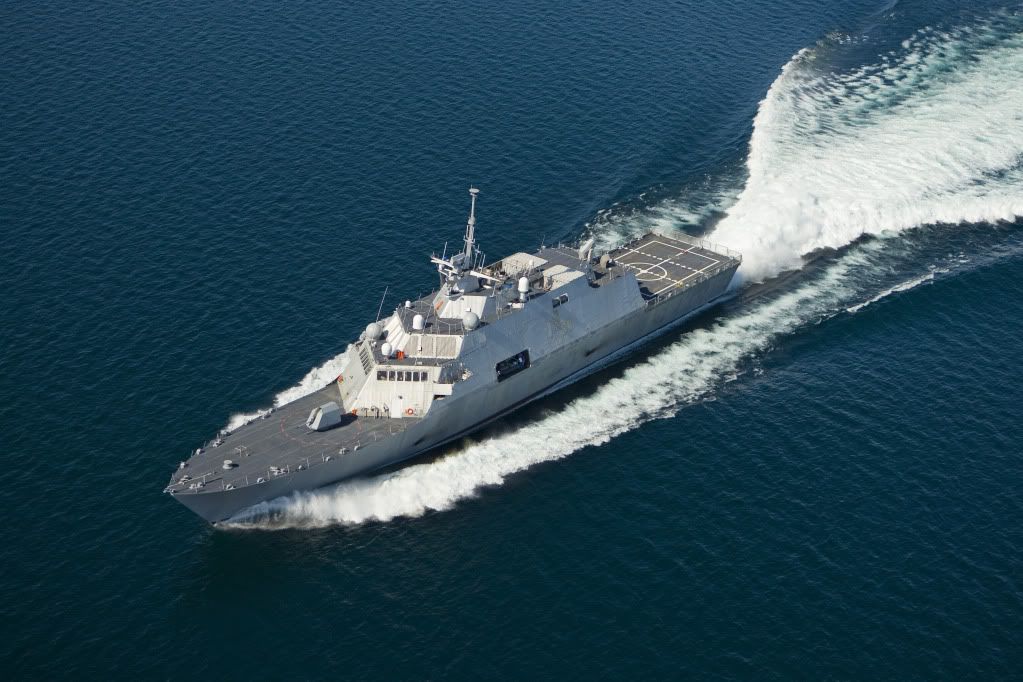
USS Freedom at sea
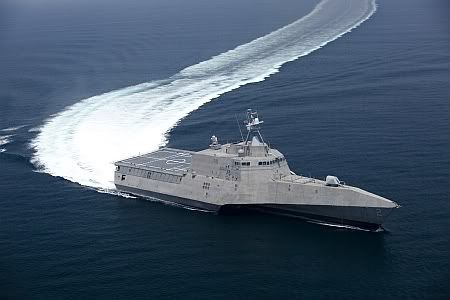
USS Independence at sea
Independence, Freedom, Corrosion and Time
Both prototype ships are operational--USS Freedom conducted her first mission in April 2010, and intercepted a narcotic smuggling boat off the Pacific coast of Colombia. This was well after the operational date intended at the inception of the LCS program, but well ahead of the pessimistic post-2007 deadlines. The Independence entered service in January 2010, but has to date accomplished even less than the Freedom.
Neither type of LCS is anything like perfect at present—they are prototypes, after all—but it begs the question of why the Navy accepted them for service at all, when both ships are plagued with grievous problems. Both Freedom and Independence suffered severe mechanical breakdowns during their first few voyages, and when the Independence completed her maiden voyage in April 2010 the Navy had to spend $5.3 million in repairs and upgrades to correct faults identified during sea trials, after General Dynamics had already spent several million dollars correcting faults already identified during builders’ trials. USS Freedom also turned out to be 6% overweight compared to her design specifications, with a significant shortfall in the reserve buoyancy that would keep her afloat in the event she is damaged, as well as serious questions about whether she can actually manage her designed speed.
USS Independence, meanwhile, suffers from severe corrosion after only a few months in service, thanks to the electrolytic disintegration of her aluminum hull, and now needs to be dry-docked for massive repairs. The cathodic protection anticorrosion system originally planned was eliminated as a cost saving measure. The Navy blames Austal’s supposedly faulty construction, and Austal blames the Navy’s supposedly negligent maintenance, though given how briefly the Independence has been in Navy hands raises the question of how fragile the ship is, if only a few months of ‘negligence’ is enough to imperil the ship’s seaworthiness and structural soundness.
It is normal for ships to require a fair bit of adjustment and modification after entering service, to address concerns identified during builders’ trials or sea trials—after all, that is the purpose of trials. The Perry-class frigates which the LCS is intended to replace, for example, suffered structural cracks up to 40-feet long in the early ships of the class, and the Perrys still active have served well for over thirty years. The severity of the LCS’s problems, however, far outstrip most of the concerns identified in previous generations of warships.
So now that we will have at least some LCS in the fleet—late and grossly overbudget, but presumably operational—will the LCS actually be worthwhile?
Both types of LCS face intense criticism on their technical merits, in addition to fulmination from more conservative big-ship advocates and flattop boosters within the Navy. The LCS program as a whole was controversial in Navy circles, if for no other reason that the LCS being the smallest seagoing warship (other than minesweepers and the like) the Navy has ordered since the 1960s. The US Navy has historically preferred bigger ships to smaller ones, when all other things are taken into consideration—if the fleet needs a destroyer, it gets a big destroyer.
There are three main criticisms of the LCS, besides cost: armament, survivability, and seakeeping, and many of the criticisms of the LCS take the form of “it’s too small, lightly armed, and flimsy—throw it out and build a Perry-class frigate.” This is decidedly ironic, since old naval constructors will doubtless remember some of the criticisms leveled against the Perry class itself when it premiered in the 1970s—“it’s too big, slow, and lightly armed—throw it out and build a Charles F. Adams-class destroyer,” or the puzzled Congressional reaction to the Spruance-class destroyers in the early 1970s—“where are all the guns?” Admittedly, the Spruance type more than twice the size of the previous class of destroyer, had less armament, and had a superstructure that looked like a truck garage.
The general sneers from the big-ship community aside, some of the technical criticisms of the LCS designs are very significant, and should not be dismissed lightly.
The Swiss Army Warship
Concerning question of armament, granted, the factory-fresh LCS is very lightly armed when compared to foreign designs of similar tonnage (e.g. the German-designed ‘MEKO A’ family used by a number of navies around the world), with only a 57mm autocannon, a close-range surface-to-air missile system, and some machine guns. In fact, many Fast Attack Craft (the antiship missile counterpart of the torpedo boat) carry more armament than a LCS on a hull 1/6 the size.
Unlike the MEKO type, however, it’s hard to say what the LCS’ real armament would include since the basic design concept is for interchangeable “mission modules.” The basic idea is that a LCS could be equipped with antiship missiles one week and then swap them out for minesweeping gear the next. Add a mission module with a couple dozen vertical launch missiles to an LCS, and it will no longer seem so under-gunned. The concept is actually fairly well-proven. The Royal Danish Navy has had success with this model since they invented it in the 1980s, although they’ve never had to use it in combat, but it’s a first in the US Navy. Both types of LCS would also operate unmanned aerial vehicles and the other types of drones that have become so widely used in the last ten years.
The Navy originally intended to buy for the whole LCS fleet a total of 16 antisubmarine modules, 24 antiship or land-attack modules, and 24 mine countermeasures modules that would be swapped out between ships depending on what the ships were being used for. Unfortunately, the antiship/land attack missile planned for the LCS, the N-LOS program, was cancelled in 2010, and so it’s not clear what the LCS would use for antiship or land attack weapons. The minesweeping and antisubmarine modules haven’t finished development either, so the LCS will spend at least a few years making do with what it was built with, as a very large speedboat and self-propelled helipad.
So far, the design is intriguing. The 55 LCS originally ordered were intended to replace 14 Avenger-class minehunters, 12 Osprey-class coastal minehunters, and 30 Oliver Hazard Perry class Frigates on roughly a one-for-one basis, covering a wide variety of rolls with one type of ship, offering great savings in manpower, maintenance costs, and long-term expenses, in addition to not having to pay upkeep costs on ships not actively needed at a given time. To put it rather more precisely, however, the LCS was conceived as a multimission ship and the Navy promptly stuck all the jobs in the ‘miscellaneous’ category onto it.
The idea of modularity is not new—the Spruance and Perry-class frigates were designed to accommodate additional weapons. The Spruances generally didn’t receive these until the late 1980s at best, when two dozen of them received 61-cell Vertical Launch Systems capable of launching cruise missiles and other weapons.
Both the Freedom and Independence types also have a substantial part of their displacement and internal volume dedicated to what is essentially flex space, that can be reconfigured based on need. In most warships of comparable size, this space is used for weapons, crew quarters, fuel, or stores. The ships have a disproportionately large hangar and large flight deck (50% larger than a Burke-class destroyer’s flight deck, and probably the single most useful thing about either LCS design) for two medium-sized helicopters such as the SH-60 Seahawk or one heavy-lift helicopter like the CH-53 Sea Stallion. A large chunk of the hull volume in either design is taken up by a ‘roll on/roll off’ cargo deck with a capacity of several dozen Humvees or light armored vehicles, or a company of troops in tight quarters.
This gives the LCS the ability to act as a (very) fast transport for Marine or Special Forces units, though admittedly this may prove to be a “too long for Dick, too short for Richard” capability. Landing a Marine Force Recon platoon in rigid inflatable boats is one thing, and can be done from virtually any ship in the fleet, but Seal Team Six isn’t in the habit of using armored vehicles on commando operations, and in any case the LCS needs a pier to offload vehicles from. In other words, the LCS may have more capability than it needs for routine helicopter and boat insertions, but not enough for bigger operations where vehicles are actually needed. If the mission is big enough that vehicles are needed, the Navy will likely assign a real amphibious ship to the job, and some of the cargo space built into an LCS would have been better used for other purposes.
Some of the missions for which the LCS is proposed seem wildly at odds with the ship’s design. In particular, the use of a half-billion dollar, 50-knot ship for minesweeping makes little sense, as minesweeping is usually done at less than ten knots using inexpensive ships that resemble fishing trawlers. The Avenger and Osprey class minesweepers currently in service are good ships and well-suited to their jobs, but although the Navy recognizes the minesweeper’s importance, minesweeping is one of the jobs the Navy really, really hates doing, much as the Army hates counterinsurgency operations. Using a LCS for minesweeping is using a proverbial sports car for a pickup truck’s job.
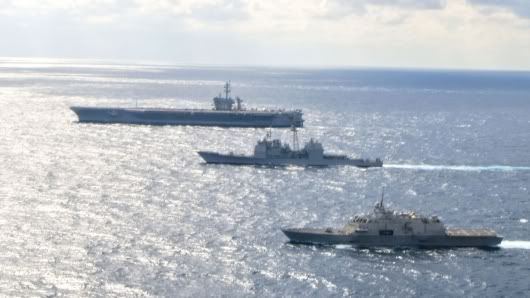
USS Freedom with an aircraft carrier and a guided missile cruiser on her first cruise
Survivability
Most significantly, since the ability to withstand damage is a major concern for a warship of any description, both types of LCS appear decidedly frail when compared to either US warships or their foreign counterparts. Both types of LCS were initially designed to ‘commercial’ standards, rather than the significantly more robust standards customary for naval warships, and were re-engineered for the navy’s new and evolving set of naval standards during construction. A formal Pentagon evaluation released in March 2011 concluded that “LCS is not expected to be survivable in terms of maintaining a mission capability in a hostile combat environment,” or in other words that the ship could easily sustain enough damage to be put out of action. The Navy has, in fact, opted to forego the usual blast testing for prototype ships—necessary to evaluate the ship’s resilience to damage-- “due to the damage that would be sustained by the ship.” That sounds like an alarming lack of confidence in the ship’s ability to keep sailors alive in battle. The Congressional Research Service confirms these findings.
Both LCS designs are engineered for what the Navy terms “Level 1 survivability” – in other words, expected to operate in the least severe combat environment and not expected to "fight hurt." This is the level of durability you build into something cheap and expendable, like a harbor patrol boat or a coastal minesweeper, not something you expect to carry commando teams in on the coast of Iran. If damaged, a Level 1 ship will be out of the fight and will probably sink, but will last long enough for the crew to get off. By contrast, Burke-class destroyers and pretty much every other surface warship in the US Navy are engineered for Level 3 survivability—the ability to take severe damage, not sink, put out fires, and keep shooting and steaming.
The Royal Navy learned a great deal about the abrupt destruction modern naval warfare can bring—HMS Sheffield was destroyed by a single Exocet missile, and a number of other British warships were also sunk or crippled by one or two hits from missiles or bombs. “Everybody had always said that modern warships are ‘one-hit ships,’ ” Sheffield’s captain observed after the attack. “Nobody had thought about the implications of a ‘one-hit ship’ 8,000 miles from home.” (Battle for the Falklands, Hastings and Jenkins 1984, 155). By the end of the conflict, the Royal Navy had barely held out through a grueling war of attrition against Argentine airpower, and the sheer number of ships lost had nearly cost the UK the victory. The USS Stark, a Perry-class frigate hit by two Iraqi Exocets in 1987, was seriously damaged but survived. Both HMS Sheffield and USS Stark were much larger than the USS Freedom or Independence, which as much smaller Level 1 ships would probably go right to the bottom.
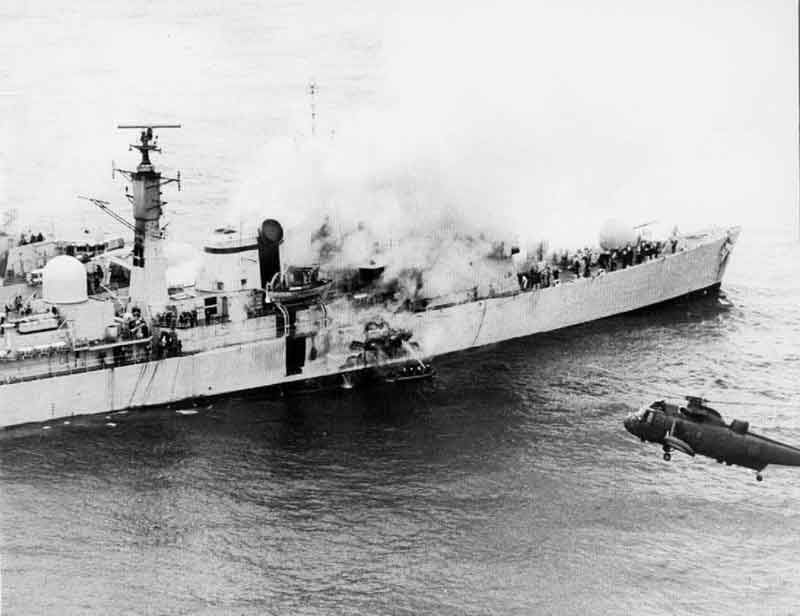
HMS Sheffield, 1982
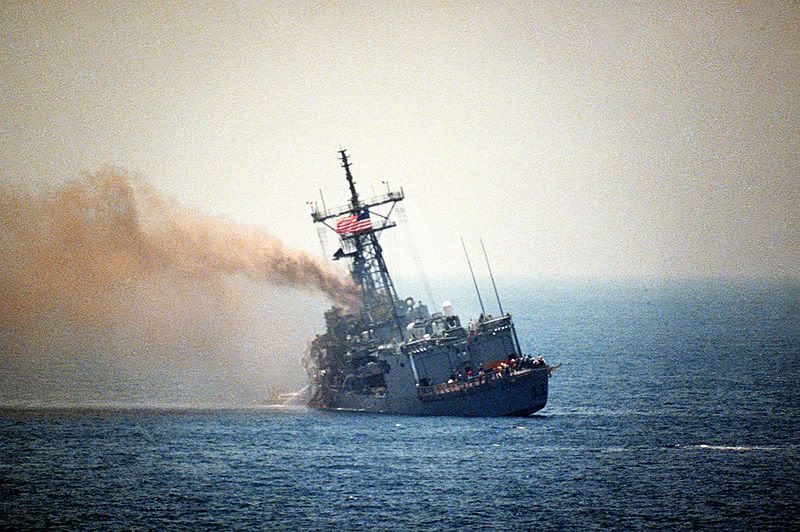
USS Stark, 1987
In view of the LCS’ proposed role, of fighting along coasts, within reach of missiles, mines, airplanes, other peoples’ warships, and even plain old gun artillery on the shore, the flimsiness and weak armament of the LCS designs is nothing short of ludicrous. The LCS are supposed to be ‘stealthy,’ with low radar and infrared signatures, but stealthy sometimes only goes so far—the Yugoslav Army managed to shoot down a F-117A Nighthawk “stealth fighter” during NATO’s 1999 intervention in Kosovo—and anything billed as a warship should be expected to suffer damage.
Still more importantly, though, is the question of how the Navy can in good conscience send sailors into a combat zone in a ship not designed to survive? The survivability issue is a big part of the US Navy’s prejudice against smaller ships, since larger ships can have more reserve buoyancy and other design features that make them more likely to survive damage than a smaller ship suffering with the same damage.
The Boat Had Better Float
Seakeeping ability is also a major concern. LCSs are intended to spend a lot of their time on patrol missions—hunting pirates, terrorists, smugglers, or mines—and the ability to stay at sea for long periods of time is important. The Navy’s big destroyers and cruisers were designed for the expanse and rough weather of the Pacific and North Atlantic, can steam and fight in anything short of a hurricane, and can stay at sea for as long as the machinery, food, and fuel oil hold out. The fast, nimble, and lightweight USS Freedom’s main engines are fuel-guzzling gas turbines which are “essentially the engines of a 777 jetliner,” and generates more horsepower than the powerplant of a much larger Ticonderoga-class cruiser. Her top speed is alleged to be nearly 50 knots, making her one of the fastest warships afloat. On the other hand, she has a maximum range of a mere 3,500-miles at a poky cruising speed of 18 knots on her diesel engines (half that of a typical frigate or corvette of the same size). That may sound like a lot, but remember that a ship has to be burning fuel and moving anytime she’s not at anchor. Freedom’s gallons-per-mile appetite also means that she could potentially go through her entire onboard fuel supply in a half-day’s high-speed running. As fast as the 50-knot Freedom is, if she wants to stay moving she’ll be forever dependent on a 20-knot fleet oiler to keep her tanked up. Current government estimates hypothesize that fuel costs will account for between 8% and 18% of the Freedom’s total operating cost over her operational lifespan. It also remains to be seen how well the Independence and Freedom will handle heavy weather, and although they’re not intended to do high-seas hunting for Soviet submarines in a North Atlantic winter, Navy warships have a two-century-long tradition of being used in roles and conditions other than what their designers expected.
Crew size, though one of the LCS program’s main selling points from the Pentagon’s point of view, is also a potential weakness. In an effort to reduce manpower needs (and the related costs) the LCS has a baseline crew of just 40 officers and men, compared to the 150-200 on a typical frigate. Although other personnel would join the crew to operate helicopters and specialized mission module equipment, for a total of perhaps 75 personnel, as it is the ships are shorthanded enough that crew coming off watch have to do double-duty even for routine tasks like refueling. On the trial cruises, this left many personnel functioning with very limited sleep. How this limited manpower would impact the ship’s company’s abilities in a combat zone, when prolonged sea duty and high-intensity operations would push the exhaustion limits, remains to be seen.
Ultimately, the LCS appears unlikely to live up to the expectations for it, in the absence of the necessary multirole equipment. In any case, it is not likely to prove a gamechanger Although small by US Navy standards, it is probably too large to be cost-effective in operation. It is too lightly constructed to survive a real war, and its armament is likely to prove inadequate. Worst of all, the cost overruns and bureaucratic disasters that have accompanied it have damaged the entire procurement process, to the point where it is a valid question whether the US Navy can actually get a usable warship on-budget and on-time. In the case of the LCS, the Navy struck out on all three pitches.
Systemic Dysfunction
In the end, this is 2011, and the US has to support two prolonged wars in two different theaters, as well as maintaining commitments in the western Pacific (particularly keeping an eye on North Korea) and other parts of the world. The economy is fragile, the government’s budget is strained, and ideological differences are splitting even the normally lavish-on-defense Republican party over the F-35 Joint Strike Fighter.
Defense cuts will continue. In the current economic and political climate, that is a certainty. Secretary of Defense Robert Gates was thoroughly justified in selecting most of the defense programs he proposed cuts for in April 2009 and January 2011, mostly because the projects cut, like the F-22 Raptor stealth fighter, are not relevant to the nation’s current needs. There are more economies to come, but twenty ships at a flat fee, even if they aren’t perfect, are better than no ships at all.
That in itself is one reason the Navy has fought as hard for the LCS as it has—whether they’re good ships or mediocre ships, the Navy needs ships, even if for no more complicated reason than replacing ships that were launched during the Nixon administration and that are now worn out.
Still, the simple truth is that the US Navy paid a combined $1.35 billion for just two warships, neither of which is actually in operational condition. That same sum, incidentally, should have paid for six ships if the program had managed to stay on-budget. The French Navy, meanwhile, managed to get the first of their Gowind-class corvettes, the L’Adroit, from the drawing board to sea trials in only two years. By contrast, the Independence took seven years (nearly as long as the aircraft carrier George H.W. Bush) and still isn’t operational. The Gowind is smaller and slower than either LCS design, but it’s perfectly serviceable and capable of performing many of the same missions. This speed is also an example of how painfully sclerotic the US Navy’s design and construction system has become. In the current economic and political climate, the longer a project lingers in development hell, the more likely it is to be cancelled. The Navy needs a ship that is what the LCS was originally supposed to be—simple, versatile, inexpensive, and possible to build and bring into service quickly and in large numbers.
In broader terms, the LCS program is an ominous foreshadowing of what could happen with other warships. Aside from the LCS planned, the Navy has approximately 50 other warships on order or under construction for the 2012-2016 period, including three DDG-1000 Zumwalt-class destroyers optimized for land attack missions, six more Arleigh Burke class guided-missile destroyers, several Joint High-Speed Vessel fast transports, several amphibious assault ships, three new fleet oilers, three nuclear-powered aircraft carriers, and five nuclear-powered attack submarines. All of this adds up to a lot of money, time, manpower, and R&D—hundreds of billions of dollars spread over years, and most of it going through the hands of a fairly small number of prime contractors like General Dynamics.
Sadly, even though about 50 other ships are under construction, that’s not even treading water. As it is, when Reagan-era ships such as the Ticonderoga-class cruisers, some Los Angeles class submarines, and the remaining Perry-class frigates reach the ends of their effective lives by the early 2020s, the Navy’s fleet will shrink by about 70 ships, or about a quarter of its current strength. The Navy is already shorthanded; although the number of missions is increasing every year, the fleet’s strength has actually declined 18% from a 2001 strength of 337 ships to a current effective strength of 285 warships, compared to a goal of 313 ships as described in a recent Congressional Research Service report and numerous Department of Defense publications. This 313-ship fleet is a long way from the pie-in-the-sky 600-ship goal of the Reagan years, but is more in line with what the Navy actually needs. The problem is in getting there, and staying there.
A navy will never have 100% of its ships in tip-top shape all at once. Right now, however, about 20% of the warships in the fleet are not combat-ready—up from only 8% in 2007—due to a combination of hard use (ships used more wear parts out quicker, and US Navy ships spend more time at sea than those of most other navies), sheer age, and deferred maintenance ($173 million worth); the Navy gets five billion dollars per year for maintenance, upkeep, and repair, which covers everything from aircraft engines to hull paint, and even $5 billion doesn’t cover everything. As it is, deployed ships on average spend nearly 40% of their time while on deployment—which could mean potentially being in harm’s way-- with at least one major system on the fritz. These system failures could include something as vital as the ship’s main gun, sonar, communications system, or missile launch and guidance controls, failures which could leave the ship undefended and endanger the lives of the sailors aboard. This lack of preparedness and the sheer numbers of handicapped warships has been an open secret for several years, but has become a matter of Congressional attention.
Even new ships need repairs—in February 2011, the USS Gravely’s topmast broke off while the ship was cruising off the coast of Florida. While accidents happen and things just break sometimes, the Gravely was only commissioned in 2010, making her practically brand-new, and this collapse raises serious questions about shipyard quality control.
The main problem is that more than half of the current fleet—from aircraft carriers on down to frigates and transport ships-- dates to the Reagan era if not earlier, and older ships require more maintenance. One reason these older ships (notably the Perrys) are still used so intensively is that their replacements have been cut from the budgets or delayed in design and construction. Another reason for intensive use of older ships is that manpower and budgetary demands during the late 1990s and early 2000s compelled the Navy to scrap entire classes of warships wholesale (for example, the 31 Spruance-class destroyers) at an accelerated rate between 1998 and 2005, faster than the ships were being replaced by new construction.
The problem is even worse for aircraft. Fifty-five percent of deployed Navy and Marine Corps aircraft are not completely mission-capable. Given how much the Navy and Marines depend on aircraft for everything from strategic reconnaissance to bomb-dropping to medical evacuations, this is a grave problem, part of what Congressman Larry Kissell phrased as “multiplied shortness there of everything that you could want or imagine or need with that ship… for every ship, then, what comes with that ship, we're missing?”
In the meantime, the number of missions needing warships has increased, thanks to two wars, a UN intervention, an anti-piracy campaign, and humanitarian commitments on several continents, on top of routine demands like training, while the number of available warships has steadily shrunk. On average, approximately 40% of the fleet’s strength is currently on deployment, twice what it was in 2000. Vice-Admiral William Burke testified before the House Armed Services Committee that the Navy high command considers this rate of deployment to be unsustainable.
There is no simple fix to this systemic failure. Over the last twenty years, the numbers of ships ordered have fallen, while prices per ship have skyrocketed, technical failings have multiplied, and delay has piled on top of delay, stretching into years of scheduling and cost overruns. Even when ships entered service, they are frequently found to be defective; this is one reason the Littoral Combat Ships haven’t been deployed for combat duty or even long-distance noncombatant operations, since the Navy is concerned that the ships could suffer serious and embarrassing breakdowns.
In other words, the Navy is putting money into the system but not getting usable ships out of it, but still has to play coverup on ship flaws because otherwise the ships will be cancelled. Bad ships, from a certain perspective, are better than no ships at all. The other armed services have much the same problem with their suppliers, but have not been so bluntly outspoken about the problem.
On the whole, there’s a hole.
Too many military development programs have collapsed over the last twenty years due to abuses and waste in the design and procurement process. Some of these programs were poorly conceived or justified—for example, the Crusader self-propelled gun. Others were badly needed but poorly-executed (the Marine Corps’ Expeditionary Fighting Vehicle comes to mind), but for a variety of reasons the project died of bloat and budget overruns. The program that eventually produced the Zumwalt-class destroyer hemorrhaged money for well over a decade before the Navy decided it couldn’t justify the program after all, and elected to build only three ships.
One hint at the future is the USS Florida, one of four Ohio-class ex-ballistic missile submarines originally built to sling nukes during World War III, but retrofitted to carry 180 Tomahawk cruise missiles instead of ICBMs. The Florida essentially shut down Libya’s air defense network overnight in March 2011, making her the most useful asset in the conflict to date, in sharp contrast to the F-22, which is for all intents and purposes useless for the sort of missions conducted in Libya or similar conflicts. A massive countrywide strike like the Florida’s is a job that even during the first Gulf War in 1991 would have required at least two aircraft carriers and their escorts, and which would have taken several days of sustained air attacks. The future will likely see increasing pressure to use more makeshifts, improvisation, or repurposed ships in order to fill needs, rather than relying on new construction.
Secretary Gates, wisely emphasized discarding decades-old gold-plated projects like the F-22 in favor of simple things that actually work, that were immediately relevant to the actual missions in Iraq and Afghanistan, and that are readily transferrable to other jobs in other places. The outstanding example of this policy is the use of unmanned aerial vehicles, which has grown by leaps and bounds since Gates entered office in 2006, and which has become a military staple in only a few years.
All parties—the Pentagon, the defense contractors, Congress, and the public—should be prepared to be very hard-nosed and pragmatic about defense spending and contracting. The era of blank-check contracts and 100% cost overruns is over. If the Pentagon expects to get its money’s worth in a harsh economic climate and with defense budgets already creaking under the strain of two wars and dozens of other operations around the world, it needs to mind its pennies just as taxpayers do.


