Swine flu is overwhelming the news lately, but there is one aspect of the problem that seems to have fallen through the cracks.
Swine flu (H1N1, as the Center for Disease Control has designated it) is not a food-borne illness; you do not get it from eating pork products. It is spread by contact between people, the same as any other sort of flu. The name ‘swine flu’ is applied because it was originally an animal illness that has started infecting humans too.
Yes, it’s a new and fairly nasty disease, but if you behave reasonably and take the precautions that you would if you knew any other flu was going around your school or office, you will be fine. Essentially, do all the stuff your mom told you to do when you were five years old—blow your nose, don’t pick; wash your hands; load up on Vitamin C and drink a lot of water; stay home if you’re sick; and go to a doctor if you really feel horrible.
The Mexican government blames the outbreak on a hog farm in La Gloria, Veracruz, Mexico, with the first human cases of swine flu identified in the vicinity of the farm in early February. The current hypothesis is that fecal particles transported by wind or insects were somehow ingested by humans, allowing the disease to make the jump to humans.
The farm in question is owned and operated by Smithfield Foods, Inc., of Virginia, one of the world’s largest food supply companies, with an annual revenue of $11 billion and an annual production of approximately 5.9 billion pounds of pork and 1.4 billion pounds of beef.
Agribusiness is big money—the 10 million hogs raised annually in North Carolina are the state’s largest cash crop, surpassing Big Tobacco with $2 billion in annual revenues. 92% of these animals are raised on factory farms with more than 2,000 animals per facility. In 1983, North Carolina had about 23,000 hog farms, most of which had fewer than 200 hogs. By 1997, however, those ratios had changed. There were now fewer than 5,000 hog farms, but the average was now 2,000 or more animals per farm, and 480 farms had more than 5,000 animals each. Most of the small farmers were simply run out of business by large conglomerates like Smithfield Foods.
Agriculture is, in the United States, a uniquely privileged industry, one that was originally exempt from many state and federal environmental protection regulations such as the Clean Air Act, Clean Water Act, and Safe Drinking Water Act, as well as wetlands and natural resource protection requirements. Some popular pesticides (such as dichlorodiphenyltrichloroethane, commonly known as DDT) were, however, specifically banned for their damaging effects on wildlife. The reasoning for this, when these regulations were created during the 1970s, reflected government and the public’s sympathetic attitude towards farmers, and a recognition of the shoestring profit margins on which most farmers lived. The Clean Water Act did, however, identify those factory farms that existed then (mostly poultry farms) as ‘point sources’ of pollutants which could affect water quality.
That was more than thirty years ago, however, and the exemptions made somewhat more sense in the 1970s than it does today, given the consolidation and industrialization that has occurred in the agriculture sector over the last three decades, and the exponentially larger number of factory farms operating today. The autonomous family farm in the United States is no longer a meaningful part of the American food supply or economy, a victim of the unforgiving need for economies of scale in agriculture, and the inability of private owners to absorb the loss of a harvest as easily as a multibillion dollar corporation. Most family farms these days are contract farms, to whom a firm like Purdue or Tyson will subcontract the work of raising and feeding animals. Most of our food is produced, processed, and provided by a surprisingly small number of immense agribusiness combines, such as Smithfield Foods, ConAgra, Tyson Foods, and a few others. Monsanto and a few other firms also hold a firm sway over the fertilizers, seeds, pesticides, and other products used to support agriculture, particularly pesticide-resistant strains of ‘Roundup Ready’ plants, which allow a farmer to blast a field with weed killer without fear of killing the wheat along with the weeds.
Farms like the Smithfield facility in La Gloria frequently cram tens or hundreds of thousands of animals into a feeding complex. The layman’s term for such industrialized operations is a ‘factory farm,’ but many regulatory agencies, trade publications, environmental groups, and others generally refer to such operations as CAFOs, which, depending on who you ask, stands variously for Confined Animal Feeding Operation, Concentrated Animal Feeding Operation, or Combined Animal Feeding Operation.
The current US EPA regulations for CAFOs, the 2008 CAFO Final Rule, define a facility as a “Large CAFO” (and thus subject to regulation under the Clean Water Act):
if it stables or confines as many as or more than the numbers of animals specified in any of the following categories:
- 700 mature dairy cows, whether milked or dry;
- 1,000 veal calves;
- 1,000 cattle other than mature dairy cows or veal calves. Cattle includes but is not limited to heifers, steers, bulls and cow/calf pairs;
- 2,500 swine each weighing 55 pounds or more;
- 10,000 swine each weighing less than 55 pounds;
- 500 horses;
- 10,000 sheep or lambs;
- 55,000 turkeys;
- 30,000 laying hens or broilers, if the AFO uses a liquid manure handling system;
- 125,000 chickens (other than laying hens), if the AFO uses other than a liquid manure handling system;
- 82,000 laying hens, if the AFO uses other than a liquid manure handling system;
- 30,000 ducks (if the AFO uses other than a liquid manure handling system); or
- 5,000 ducks (if the AFO uses a liquid manure handling system).
These are minimum thresholds, you understand—some facilities have ten times the number of animals needed to qualify as a Large CAFO. There is also a category called the Medium CAFO, which can cover smaller facilities with more direct potential for impact on the environment.
A CAFO can be summarized as an enormous number of animals crammed into a few buildings, unable to move more than a few feet in any direction, and essentially living in their own feces. Lots of animals mean big barns and enormous amounts of poop. Two years ago, I worked on a commercial poultry farm that had housed 25,000 turkeys, which is small by CAFO standards—some poultry farms in the Midwest, in the MidAtlantic, or elsewhere can house ten times as many birds. I can personally attest that the floors in these buildings were covered to the depth of a foot with excrement, wood chips, and the skeletal remains of dead turkeys, and that even months after the business had ceased operating, the stench was eye-watering.

Pigs in a CAFO facility.
Animals understandably do not thrive under these brutal conditions without substantial assistance from mankind, so it should be no surprise that factory-farmed animals are typically pumped full of hormones, antibiotics, and other substances from the day they are born until they are slaughtered. Diets are carefully adjusted to produce the most lean meat per animal for the least cost, which in some cases has a deleterious effect on the meat that is the end result—this is why pork is so much more lean now than it was ten years ago. Likewise, most factory-farmed cows are fed a steady diet of corn, which is cheap but fibrous, not easily digestible, and not very nutritious when compared to the grass that a cow is biologically structured to eat, which is why cows have to be stuffed full of nutritional supplements and pharmaceuticals.
Meat is not murder. Meat is manufacturing.
By contrast, the rule of thumb for non-industrial cattle raising, as suggested by the Ohio State University Agricultural Extension Program, is five acres of land per cow. A CAFO can raise hundreds or thousands of cows on the same land area, because it doesn’t depend on land area and grazing—it just locks the cows in stalls and shovels in the corn. Thirty years ago, treatment like this earned the raising of veal calves lasting opprobrium as an inhumane way to raise an animal, but it is for all intents and purposes how most cows are raised in the US today.

A typical CAFO, showing barns, lagoons, and support buildings. Photo courtesy of US EPA.
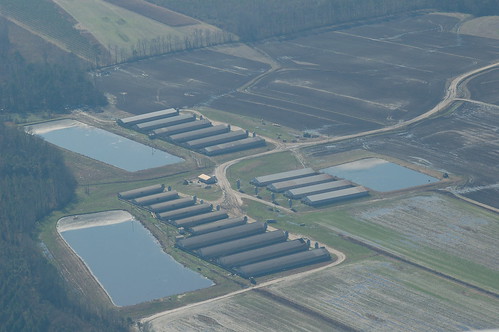
The large oblongs next to each group of barns are the manure lagoons. Guess why the fields in the above photos are that dark brown color.....
One of the most odious aspects of the livestock industry is the poop the animals produce, and which they by definition produce in almost unimaginably vast quantities. Nationwide, farm animals produce an estimate 1.6 billion tons of excrement per year. Some sixth-grade math will tell you that the farm animals produce in one day what the human population of the United States produces in three years.
Now imagine a factory farm in rural Iowa or Michigan holding ten thousand cows. A cow typically excretes twenty to twenty-five pounds of poop per day, or approximately ten times as much as an adult human. Ten thousand cows, then, produce 200,000 to 250,000 pounds of poop per day, equivalent to the excrement produced by the human population of the city of Manchester, NH. One dairy alone, the Vreba-Hoff II facility in Michigan, has a storage capacity of 22 million gallons of poop.

Vreba-Hoff Dairy II, south of Hudson, Michigan, partially flooded in 2003.
Unlike the collective daily bowel movements of the Queen City of New Hampshire, however, the poop produced by these ten thousand cows does not go into a sewer and does not go to a treatment plant. It goes, if we are lucky, into a storage lagoon the size of a football field, and there it sits. And sits. And sits. All through the hot summer, swarmed by flies, reeking to high heaven. Eventually, it may be composted, dried and sold as a fertilizer (such as the ever-reliable Bovung) or most likely, diluted into a slurry and sprayed onto fields. Poop, as any backyard gardener knows, can be a very valuable and useful commodity for growing plants, serving as a fertilizer and soil restorative. Given the sheer quantities of poop produced at a CAFO, however, the unfortunate facility manager is now often faced with the prospect of having more poop than he can use, forcing him to apply more than the appropriate amount of poop per acre (18.7 tons of wet-weight hog poop per acre being an industry rule of thumb, and worth about $50 at current prices), applying poop to frozen ground during the winter, or onto wet ground, just in order to free up lagoon space. These are not recommended practices, since the poop just runs off the ground surface without improving the soil and winds up in the nearest stream, pond, or other drainage nexus.
Any individual CAFO has the potential to become a collective colonic cornucopia, a fecal Frodi’s Mill which produces more excrement than even the best-intentioned crew can handle, leaving the CAFO’s staff running around like sorcerer’s apprentices trying to get rid of it all.
That practice spraying onto the fields, and the potential for the poop to affect streams and other waterways, was the subject of a 2003 rule issued under the Bush Administration by the Environmental Protection Agency, which required CAFOs to obtain National Pollutant Discharge Elimination System (NPDES) permits under the Clean Water Act. A NPDES permit, which can cover anything from an industrial wastewater treatment system to a construction project’s runoff controls, allows a party to discharge a certain quantity of material into a waterway, within strict limits and requiring chemical treatment and other safeguards to minimize the environmental impact of the discharge. The 2003 rule was itself the result of a 1992 consent order issued by a court in response to a suit by the Natural Resources Defense Council, which essentially told the EPA it had to do its job whether it wanted to or not. The 2003 rule, however, essentially rendered the NPDES requirements essentially toothless, since it gave CAFO operators a free hand in deciding on their own what ‘compliance’ meant, in addition to specifically exempting them from several important and longstanding federal regulations:
• The rule allowed factory farms to write the part of their permits that limit spraying poop on fields without state or federal review or approval, and without notifying the public. The preparation of permits is usually done either by government officials, or the permits are subject to government approval.
• The rule did not require CAFOs to use technological controls to reduce bacteria and other pathogens in the manure, even relatively simple and inexpensive technologies like methane digesters and odor controls.
• The rule exempted factory farms from meeting water quality standards.
These exemptions meant that any NPDES requirements essentially existed only on paper, without any real effect on the CAFO’s adverse effect on human health and the environment.
The Waterkeeper Alliance, the Sierra Club, and the Natural Resources Defense Council, and filed a suit against the EPA in 2005, alleging that the 2003 rule had violated not only the 1992 consent order, but the Clean Water Act itself, thus putting the EPA in the awkward position of having violated a law which it is charged with enforcing. The Second Circuit Court of Appeals agreed, threw out the 2003 rule, and ordered the EPA to start afresh, with specific requirements for pollution controls and public notification of permits.
Innumerable local initiatives have been launched over the last ten years to draw public attention to CAFOs and their environmental impacts, including Environmentally Concerned Citizens of South Michigan, who maintain the website www.nocafos.org.
This is not 1900 or 1950, when after milking the cows a boy growing up on the farm could wander down to the creek for some idyllic fishing. Not only are there probably no fish in the creek now, let alone any fish safe to eat, but the smell of the water alone would probably make a prospective fisherman nauseous.
In 1895, over a century ago, the New York State Department of Health considered a four-square-mile area of waterway adequate to absorb the 11,350 pounds of raw sewage produced daily by a neighborhood of five thousand people. Granted, that was nineteenth-century engineering and displayed a degree of conservatism and caution that fell out of favor over the succeeding eight decades, but it does put the sheer quantities into perspective.
The vast amounts of animal poop introduced into the nation’s rivers, ponds, wetlands, lakes, and so on easily overwhelms most of the natural ecological processes, converting streams into vast open sewers worthy of Calcutta, India. Several of the Great Lakes, a large part of the Florida Everglades, and the Chesapeake Bay are virtually biologically dead, due to the combined uncontrolled runoff from tens of thousands of acres of agricultural land.
Assume a hog farm CAFO in North Carolina, with two thousand hogs. A hog will produce about two tons of poop in one year. Two thousand animals times two tons of poop per animal per year equals four thousand tons of poop—enough to cover a football field to a depth of eighteen feet, or to fertilize 213 acres of farmland. Much of that poop could, however, wind up flowing into nearby waterways, or even seeping into the ground and contaminating aquifers.

A worst-case situation—a CAFO on the Cape Fear River in North Carolina, with feeding barns, poop lagoon, and visible flooding that would carry enormous amounts of contamination into the adjacent river.
Rainwater, floodwater, or irrigation runoff, which account for most of the material carried into waterways, can transport dissolved solids (such as fecal particles) as well as ammonia, phosphorus, hydrogen sulfide (the asphyxiating and potentially corrosive ‘fart gas’), organic acids, bacteria, viruses, parasites, fertilizers, pesticides and herbicides, pharmaceuticals, and various other undesirable materials, all of which winds up in the stream, lake, etc. The result is not so much a stream as a noxious brown soup unable to support life.
Many of these substances, such as bacteria (notably fecal coliform), phosphorus, and ammonia are also found in human-derived sewage, in which case they must be treated in a wastewater plant or septic system (which is a wastewater treatment plant in miniature) to protect human health and the environment. The exponentially larger quantity of animal poop, however, is not require to be so treated, and in most cases does not even receive the more cursory runoff controls generally required of construction projects.
Ammonia, which accounts for the eye-watering reek of mammal urine and bird excrement, presents a particular problem. Ammonia is by itself a weak base, with a typical pH of 4.5, and if enough of it reaches a water body it can alter the pH of the water to the point where it’s no longer suitable for native plant and animal life. Ammonia is, however, a nitrogen compound (NH3) and when it breaks down it releases nitrogen into the environment. Nitrogen is great as a nutrient for plants, but sometimes it is too great. When introduced into water bodies in vast quantities such as agriculture produces, it provides a surprise banquet for algae, microscopic plants that live in water, resulting in ‘algae blooms,’ in which the water becomes so clogged with algae that nothing else can live there. Fish, frogs, newts…. Everything but the algae has to leave or die.
Human health is also potentially at risk, since poop or the chemical constituents thereof can leach into groundwater, rendering the water unsafe to drink due to contamination with fecal coliform, nitrate, nitrite, and other compounds. Tyson Chicken settled in 2004 a $7.4 million lawsuit brought by the city of Tulsa, Oklahoma, which found that Tyson’s operations had contaminated the city’s potable water supply (drawn from municipal groundwater wells) with alarming levels of phosphorus. Tyson Chicken has been found guilty of twenty separate violations of the Clean Water Act for its Sedalia, Missouri plant, although this was a processing facility and not a CAFO, as well as facing suits and racketeering allegations about the deliberate recruiting of illegal immigrants as factory labor. Smithfield Foods was the subject of the third-largest civil penalty ever levied under the Clean Water Act in 1997, a paltry $12.7 million – 0.035% of the company’s 1997 earnings. Other potential pathways for CAFOs to affect public health are through air quality degradation through fecal particle and gaseous emissions, and damage to other crops, fish, or other livestock in the vicinity of the CAFO that people could consume.
The bottom line is that although poop is an animal product, in the context of modern industrialized agribusiness it is an industrial waste and should be regulated as such. The natural environment could absorb the waste generated by ten thousand cows if they were spread over fifty thousand acres, but ten thousand cows concentrated in five acres is a contaminant source that overwhelms natural processes and damages the environment. This is not the liberal establishment picking on Ma and Pa Kettle. This is a matter of industrialized big business, the equivalent of the public’s realization thirty years ago that hazardous wastes posed a clear and present danger to human health and the environment. The nation owes it to itself to address the problem before we have another disaster on the scale of Love Canal.
As a footnote to the above, there remains one major issue which must be addressed, which is the safety of our food supply. Within the last two years, we have seen panics over peanut products, dog food, beef, Malt-O-Meal cereals, Nestle candy bars, and Gerber cereals. Given the relatively small number of hands our food supply passes through these days, a failure in one plant or factory farm can have enormous ramifications. If a Tyson Chicken plant has a bad day, all of the 100,000 birds processed that day could potentially be contaminated, a problem that may not be caught for months or weeks afterwards.

